



Japanese Koi, the king among pond fish
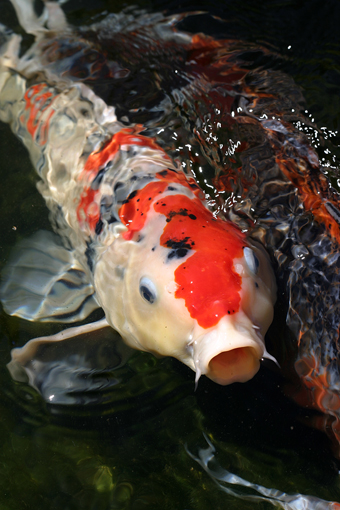 Japanese Koi symbolize courage and strength. They are strong fish that can even swim upstream. These beautifully colored fish can grow very old and quite large. As much as 70 to 80 centimeters and over 40 years old. A Koi is called “Nishikigoi” in Japan. Nishikigoi comes from the words ‘Nishiki’ which means ‘colorful dress’ in Japanese and ‘Goion Koi’ which means ‘carp’. So freely translated, this is ‘colored carp’. Contrary to what many people think, the Koi is not a Japanese fish; it is originally from Iran. Breeding for color began in Japan about 200 years ago.
Japanese Koi and care
The Japanese Koi needs a large pond. At least 150 cm deep and 1,000 liters of water per Koi. In addition, a powerful filter is also necessary as well as extra oxygen, because plants can only be kept in so-called floating plant islands. This is because the Koi eat the plants. Many Koi keepers therefore choose a separately located helophyte filter. Then you have the advantages of the biological function of plants, but not in the same pond as the koi.
General data Japanese koi
| Name: | Japanese Koi or Koi |
| Length: | 70 to 80 cm |
| Appearance: | White, red, black spotted |
| Age: | Up to 40 years of age |
| Feed: | High quality koi food with vitamins, minerals and extra chicory |
| Pond: | At least 150 cm deep, no pond plants (unless in floating baskets), extensive filtration system essential |
| Protection: | Necessary! |
There are many varieties of Japanese Koi. And these divided into 11 different groups.
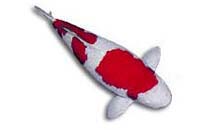
The Kohaku are white with red (hi), where the white should be as white as snow and the red deep red.
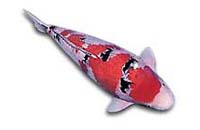
The Sanke is a white koi with red (hi) and black (sumi) spots.
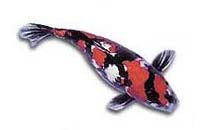
The Sanke is a white koi with red (hi) and black (sumi) spots.
The Showa, like the Sanke, has three colors, the difference being that the Showa is mainly black with red and white spots.
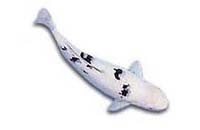
The Bekko is a white koi with sumi spots that are full and
deep black.
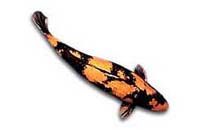
The Utsuri is mainly black with yellow, white or red spots.
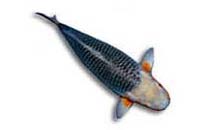
The Asagi Magoi has blue-black markings with light blue or white edges around the scales; red on the cheeks, fins and sides.
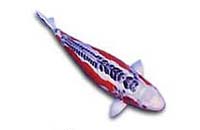
Shusui are actually doitsu asagi. Shusui also have the ability to darken in cold water.
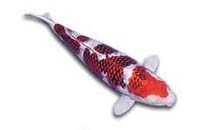
The Koromo is a cross between the Kohaku and the Narumi Asagi.
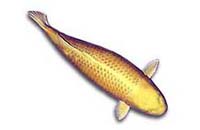
The Hikarimono are better known as the Ogon. They are usually gold or silver metallic in color.
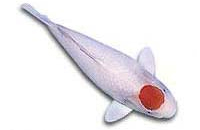
The Tancho is undoubtedly one of the most popular types of koi. A Tancho is a Kohaku, Sanke or Showa with a red spot on the head.
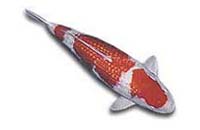
Kinginrin literally means “golden (Kin) silvery (Gin) scales (Rin).
