



The sturgeon, a prehistoric fish
The sturgeon is native to the former Eastern Bloc including Russia, Romania and Hungary. In the wild, the fish can grow as long as six meters with a weight of up to 400 kilograms. It lives to be about 50 to 100 years old. It is a beautiful fish with an almost prehistoric appearance. It also looks a bit like a shark. The fish is among the most primitive among bony fishes. Whereas the fish used to be found in all major European rivers, it has now virtually disappeared except for a few small populations.
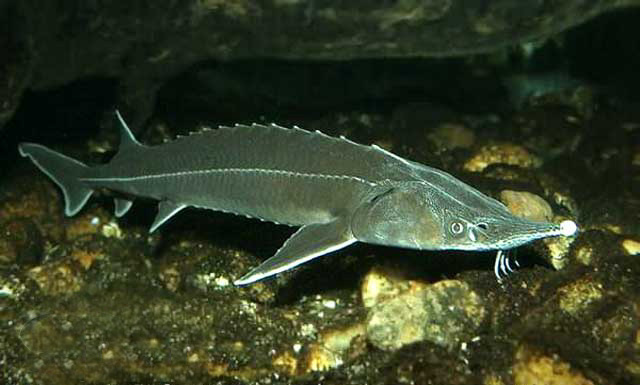 The sturgeon is by nature a strong fish that does not get sick easily. However, it is a fish that can grow very large in the pond, even if it takes a long time. The pond should therefore be at least 120 centimeters deep everywhere and have very few plants. Keep in mind that per sturgeon you have 1000 liters of water in your pond. A powerful filter is also necessary because the sturgeon likes flow. At the bottom of your pond the sturgeon likes a layer of mud and absolutely no sharp pebbles or sand because he is sensitive to these.
Considerations for the sturgeon
If you want to keep sturgeon in your pond, there are a number of concerns to consider. A sturgeon needs special sturgeon food because its mouth is at the bottom. The food sinks to the bottom and has a very strong smell, so it resembles its natural food. The sturgeon is a bottom dweller that lives in cold flowing and highly oxygenated water. A sturgeon does not have sufficient ability to pump water around with its gills, so it will have to swim like a shark to breathe in enough oxygen. Good aeration and space in the pond is therefore necessary.
The sturgeon cannot swim backwards. In a pond with plants or filamentous algae, a sturgeon quickly gets stuck and drowns. Especially smaller specimens are not strong enough to swim freely and can lose their lives in even a small piece of filamentous algae.
Feed for the sturgeon
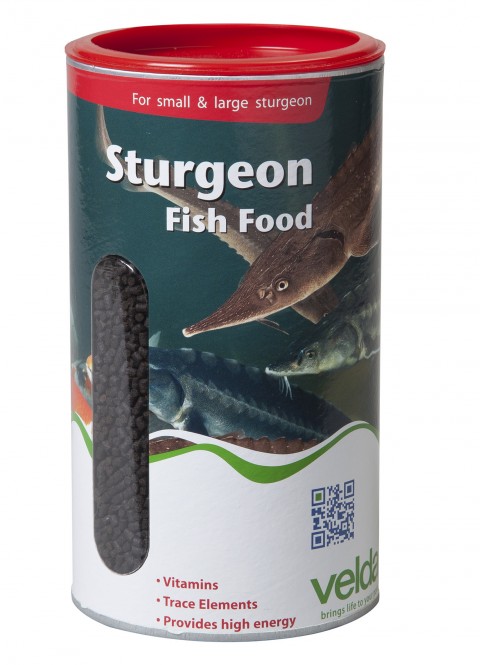
Do you want a sturgeon and koi in one pond? Then keep in mind that a koi often finds the sturgeon food faster than the sturgeon itself. Especially small sturgeon die of starvation this way. It helps to feed the fish at the same time and place every day. You thus teach the fish where their food is. Distracting the koi on the other side of the pond gives the sturgeon a little more time. Sturgeon food has a different composition than koi food, it is much fattier and in winter not suitable for feeding koi. Better to give the sturgeon then sinking koi food. In the range of Velda we have two types of sturgeon food and we also recommend to give this food to the sturgeon. It is balanced and optimally formulated for the sturgeon. Available at all major garden centers: 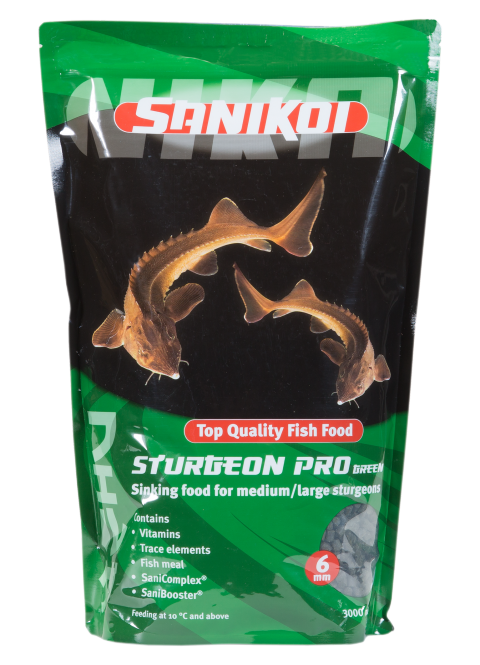
The bottom of the pond must be kept clean. Accumulating debris can cause gas formation, which can cause the sturgeons to become ill and die. This is because the bacteria consume all the oxygen in the layer of water where the sturgeons spend the most time. So a good bottom drain is a necessity.
Sturgeons up to 20 centimeters must be fed every 3 hours or they will die. A fish feeder is then a useful tool.
As a rule of thumb, a sturgeon needs a pond at least 10 times the length of the fish. And they grow quite a bit during the first 7 years.
General data of the sturgeon
| Name: | Sturgeon |
| Length: | Up to 120 cm and larger |
| Appearance: | Gray-brown |
| Age: | 50 to 100 years old |
| Feed: | High quality sinking feed with fats, vitamins and minerals |
| Pond: | At least 120 cm deep |
| Protection: | Not necessary |
